
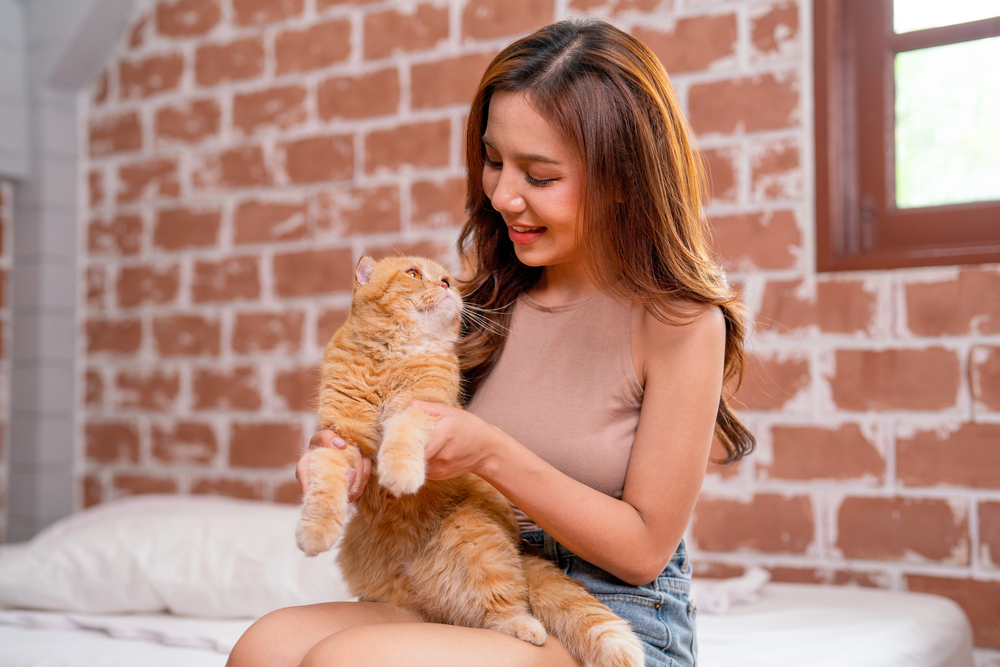
If you share your home with a cat, you already know that their presence feels different than mere “pet ownership.” Their timing, their gaze, the way they wordlessly appear when you are sad and vanish when you are agitated, carries an almost intuitive intelligence. In depth psychology, cats often symbolize the anima—the subtle, feeling-tone of the psyche that perceives without logic, knows without argument, and restores through presence rather than fixing.
Alongside their symbolic role, there is physical mystery as well: a cat’s purr may truly be medicine. Studies suggest that the frequency range of a cat’s purr (25–150 Hz) promotes bone healing, muscle recovery, and decreased inflammation—so much so that similar sound frequencies are used in European sound therapy to aid osteoporosis and tissue repair.
Cats do not suffer bone and muscle disorders the way many animals do; their purr is theorized to be an evolutionary adaptation that maintains bone density during long periods of rest. In other words, stillness itself becomes a healing state in the feline body. There is poetry in that: vibrational stillness as restoration, a lesson many humans forget.
But perhaps their most potent medicine is not physical. Those who grieve, who are overwhelmed, who have lost direction or relationship often describe the same scene: a cat quietly settles nearby—not demanding, not solving, simply staying. This is the anima-function embodied: non-intrusive attunement. Cats do not argue you out of despair; they sit with you until the inner weather changes on its own terms.
Below are a few ways cats — and pets in general — support emotional and psychological healing:
Mindfulness and the Intuitive Present
Animals are naturally present-centered. They do not ruminate or rewrite conversations from three weeks ago. A cat grooming itself in a sunbeam is not practicing mindfulness — it is mindfulness. Being with an animal shifts the brain from conceptual thought to perceptual awareness — touch, warmth, fur against the palm, the sound of breath. Many people describe that simply watching a relaxed cat slows the tempo of their internal world.
Structure and Rhythm
Grief and upheaval disrupt time. Days blur. Nights lengthen. Caring for an animal offers small anchors of continuity — feeding, fresh water, fresh air — and these tiny rhythms help reestablish the architecture of a day. Structure is not control — it is safety. Pets create micro-rituals that remind the nervous system, “Life continues here.”
Responsibility that Doesn’t Overwhelm
Supporting a living creature brings with it meaning that is not abstract, performative, or career-based. It is grounded. Response-ability — the ability to respond — often restores agency when trauma or depression have shrunken the world to survival. Caring for a cat who simply curls against your leg afterward is altruism held lightly.
Unconditional Regard
Many emotional injuries arise from conditional acceptance — love tied to performance, worth measured by output or self-erasure. Animals offer something different: affection without curriculum. They make room for you as you are. Depth psychology would call this corrective emotional experience — psyche learning that openness does not always lead to shame.
Embodied Social Contact
For those navigating grief, divorce, relocation, illness, or the emptying of a home, the loss of social connection is often as painful as the loss itself. Pets are bridges — not only to others, but back to oneself. They soften the threshold of re-entering relational life.
Healing Touch and Co-Regulation
Touch is the first language of safety and regulation. Stroking a cat or dog slows breathing and calms the heart by releasing oxytocin and quieting adrenaline. What some call “petting the animal” might more accurately be co-regulating nervous systems.
Self-Soothing, Rest, and the Art of Knowing When Enough is Enough
Cats stretch, sleep, seek warmth, reposition, withdraw when overstimulated, and return when ready. They model the restful self-adjustment many of us unlearn. The psyche requires cycles — heat and cool, engagement and retreat — yet our culture prizes endless output. Cats refuse this myth with quiet authority.
Perhaps that is why they so often appear when someone is grieving, heartbroken, or lost. They do not encourage emotional bypassing or premature brightness. They embody a truth: not everything is solved — some things are simply attended to.
Sometimes the most intuitive therapists have whiskers.